Last updated: 2026-08-10 · By Abdul Razzaq · ~14-min read
TL;DR — A Shopify Plus developer in 2026 lives at the intersection of Liquid, the Admin GraphQL API, Checkout Extensibility, Shopify Functions, Flow, and B2B on Shopify. Regional rates run from US$25/hr in Lahore to US$350/hr in New York for the same skill set. The gap between a Plus developer and a generalist Shopify dev is measured in shipped Plus work, not years on a resume.
I’ve spent the last four years working almost exclusively inside the Shopify Plus ecosystem, including a 50,000-SKU enterprise apparel migration off Magento Commerce, the AWH Ekken multi-tenant dealer portal that runs a wholesale catalogue for dozens of automotive retailers, and the Javson Sports Figma-to-Shopify build with a B2B pricing layer on top. Across those builds and the Plus consulting engagements I’m currently running, the same six or seven capabilities keep showing up in every project brief, and the same handful of tools keep earning their spot in the stack.
This guide is written for two audiences at once. If you’re a founder or hiring manager evaluating who to bring on for a Plus build, it maps what a Shopify Plus developer actually does day to day, what the honest 2026 rate ranges look like by region, and where hiring goes wrong. If you’re a mid-level Shopify developer thinking about specializing up into the Plus tier, it lays out the skills stack in the order I’d learn them today, the tools worth investing time in, and the path from “I know Liquid” to “I ship Checkout Extensibility work for enterprise merchants.” Either way, the goal is the same: strip the marketing off the Plus developer title and describe the job accurately.
What a Shopify Plus developer actually does
The direct answer: a Shopify Plus developer builds and maintains the parts of Shopify that only unlock on the Plus plan. That means Checkout Extensibility at the full API surface, B2B on Shopify with Company Accounts and buyer-specific pricing, higher-ceiling Shopify Functions, expansion-store architecture, and the enterprise integrations (ERP, PIM, WMS) that come with mid-market and enterprise merchants. It is not the same job as building a Basic Shopify theme with a few custom sections.
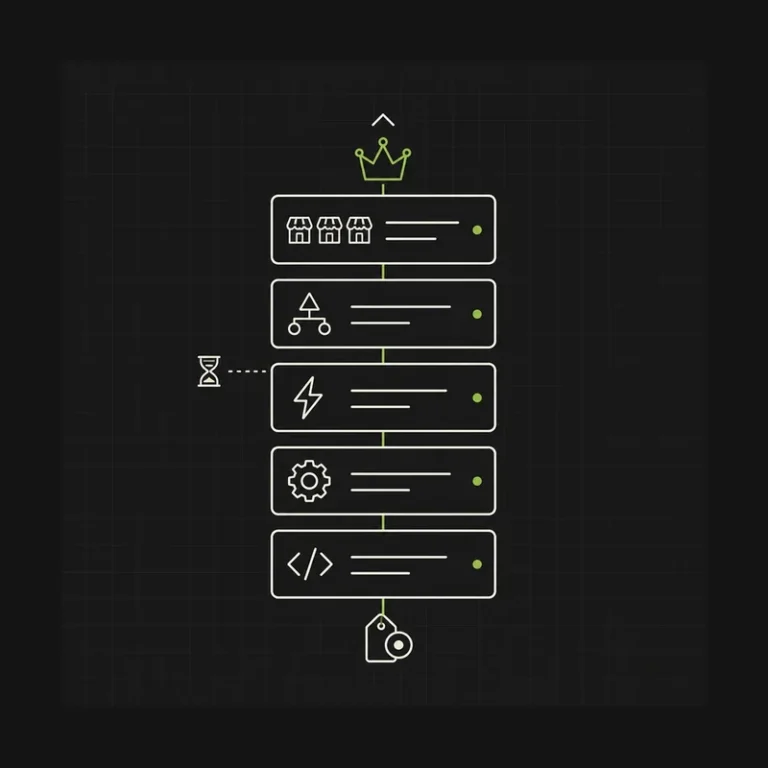
The day-to-day of a working Plus developer breaks down into five recurring buckets:
- Storefront work in Liquid, with Sage/Bud or a Hydrogen headless setup for the headless projects. This is the shared surface with generalist Shopify devs, but at the Plus tier it usually includes a design system big enough that content teams edit metaobjects instead of touching Liquid.
- Checkout work using Checkout UI Extensions and the underlying Checkout Extensibility APIs. Custom branding, dynamic upsells, region-specific compliance flows, gift-with-purchase mechanics that Advanced-tier apps cannot cover.
- Functions work in Rust or JavaScript. Discount logic, delivery customization, payment customization, cart transforms. Shopify Functions are available on all plans, but Plus merchants get the higher execution ceilings that make complex logic viable in production.
- B2B work on the B2B on Shopify primitives. Company Accounts, per-buyer catalogues, price lists, net-terms invoicing, location-scoped ordering. This is where AWH Ekken and Javson Sports both spent the majority of my dev time.
- Integration and automation work using Shopify Flow, the Admin GraphQL API, private and custom apps, and third-party ERP or PIM connectors. The volume of this work scales fast with catalogue size and channel count.
There’s an unglamorous sixth bucket that every honest Plus developer will admit to: operations. Multi-store contracts, expansion-store launches, staging-environment discipline across expansion stores, checkout deprecation migrations (Shopify has been moving merchants off checkout.liquid on a published timeline), and the Rewind or Matrixify recovery work that follows any bulk change. A generalist Shopify dev can dodge most of this. A Plus developer cannot.
The distinction that actually matters when you’re hiring: a generalist Shopify dev builds and customizes stores. A Plus developer builds and customizes stores plus the enterprise infrastructure around them.
The core skills stack, ranked by how often they show up in a real Plus brief
The direct answer: ten capabilities cover roughly 95% of what a working Plus developer touches in a year. They are ranked below in the order they show up on Plus project briefs I’ve received in the last 24 months, not in the order textbooks teach them.
| # | Skill | Why it’s on the list | Reference |
|---|---|---|---|
| 1 | Liquid | Every Plus theme, every custom section, every checkout extension that still touches theme code | shopify.dev Liquid reference |
| 2 | Admin GraphQL API | Every non-trivial integration, every bulk operation, every custom app | shopify.dev Admin GraphQL |
| 3 | Checkout UI Extensions | The single fastest-growing Plus deliverable in 2026 | shopify.dev checkout-ui-extensions |
| 4 | Shopify Functions (Rust or JS) | Native discount, delivery, payment, and cart-transform logic replacing app stacks | shopify.dev Functions |
| 5 | Shopify Flow | Org-level automation across expansion stores, VIP tagging, order routing, refund workflows | shopify.dev Flow |
| 6 | B2B on Shopify | Company Accounts, buyer catalogues, price lists, wholesale checkout | shopify.com/plus/solutions/b2b-ecommerce |
| 7 | Storefront API + Hydrogen | Headless builds, custom storefronts, subscription checkouts | shopify.dev Hydrogen |
| 8 | Metafields and metaobjects | Custom data models that keep content editable without engineering time | shopify.dev custom data |
| 9 | Multi-store and expansion stores | Consolidating multi-market or multi-brand operations under one Plus contract | help.shopify.com Plus features |
| 10 | Sage/Bud/Vite theme build pipeline | Modern build tooling that Plus agencies increasingly expect | Roots Sage documentation |
Two observations from actually working through this stack on live briefs.
First, Liquid is still the floor. Every headless-only Plus developer I’ve worked alongside eventually has to touch a Liquid theme for one of the merchant’s expansion stores, one of their integrations that still depends on the theme surface, or a checkout deprecation migration. Skipping Liquid to jump straight to Hydrogen is the single most common gap I see in mid-level developers pitching themselves as Plus-ready.
Second, the Admin GraphQL API has quietly moved into second place. Five years ago the REST Admin API was where most integration work happened. In 2026, almost every serious Plus integration I ship starts with the GraphQL client because the rate-limit ceilings are more forgiving for bulk operations and the cost model is easier to reason about at scale. On the 50K-SKU migration, the GraphQL bulk operations API was the single biggest reason the initial catalogue load finished on schedule.
Skills 3 through 6 — Checkout Extensibility, Functions, Flow, and B2B — are the four that separate “Plus developer” from “Shopify developer with an interest in Plus.” If a candidate can’t discuss all four fluently, they’re a generalist positioning as a specialist.
The tool stack I actually use in 2026
The direct answer: a Plus developer’s tool stack in 2026 is more opinionated than the Shopify docs suggest, because half the tools that ship with the CLI are either dated or optional. Here is the working set from my current Plus consulting engagements. Every tool listed has earned its spot on a shipped project, not just a tutorial.
- Shopify CLI — for theme development, app scaffolding, Functions builds, and Checkout UI Extension local dev. The one non-negotiable tool.
- ngrok — for exposing local app dev servers to webhook testing. The Shopify CLI does its own tunnel now, but ngrok is still the fallback when the CLI tunnel misbehaves on enterprise networks.
- VS Code with the Shopify Liquid extension, or Cursor — Cursor’s Claude and GPT-integrated editing has quietly overtaken plain VS Code for me on the Plus builds where I’m generating a lot of Liquid section boilerplate. Both work.
- Git and GitHub — every Plus repo I ship lives in a client-owned GitHub org, not mine. Merchant retention of source control is a hiring signal I test candidates on directly.
- GitHub Actions for FTP-style theme deploys — the pattern from Sage plus the Shopify theme push action is what powers zero-downtime deploys on the projects I run. Cleaner than manual
shopify theme push. - Composer and npm — Sage’s Blade templating on the WordPress side and Vite bundling on the Shopify side. Every Plus theme I’ve inherited from another agency in the last 18 months uses some variant of this pipeline.
- Sage and Vite — for the modern build pipeline itself. Vite’s HMR is where the day-to-day dev experience actually lives.
- Matrixify — for bulk product, customer, and metafield import/export. The 50K-SKU migration would have taken twice as long without Matrixify’s chunked import model.
- Rewind — for automated backups of themes, products, and metafields. Every Plus merchant should run this by default, and every Plus dev should insist on it before making bulk changes.
- Postman or Bruno — for Admin API and Storefront API testing. Bruno is the newer, offline-first alternative I’ve moved to for anything I want in Git alongside the code.
- LogRocket and Sentry — for production monitoring on the storefront (LogRocket) and the app or Functions layer (Sentry). Not optional on enterprise merchants where a five-minute checkout regression is a five-figure event.
- Notion — for merchant-facing project docs, acceptance criteria, and change logs. Every Plus project I run has a shared Notion page the merchant’s team owns.
The tool stack changes maybe once every 12 to 18 months. Anything more churn than that is a signal you’re chasing hype instead of shipping.
Honest Shopify Plus developer rates in 2026, by region
The direct answer: Shopify Plus developer rates in 2026 span roughly US$25/hr at the low end to US$350/hr at the top end, driven far more by geography than by skill differential. The table below reflects the ranges I’ve observed across my consulting network and from the Plus rescue projects I get called into.
| Region | Typical Plus dev rate range | Notes on what’s normal |
|---|---|---|
| US (major metros) | US$150 to US$350/hr | Senior specialists at Plus agencies, or top-tier US freelancers |
| US (secondary metros) and Canada | US$120 to US$220/hr | Mid-to-senior independents with 3+ Plus builds |
| Western Europe (UK, Germany, Nordics) | US$90 to US$200/hr | Rates rising fast as Plus agencies consolidate |
| Eastern Europe (Poland, Romania, Ukraine) | US$60 to US$130/hr | Deep talent pool, common outsource destination |
| APAC (India, Pakistan, Philippines) | US$25 to US$80/hr | Senior work at cost-of-living arbitrage rates |
| LatAm (Argentina, Brazil, Mexico) | US$30 to US$85/hr | Growing rapidly as US brands hire nearshore |
My own rate is US$25/hr, billed from Lahore, on projects that would sit at US$150 to US$250/hr if I were billing them from New York or London. That is the cost-of-living arbitrage in action, not a signal about senior versus junior work. I’ve been in the Shopify ecosystem for 7+ years and shipped 50+ stores with 5★ across 30+ reviews on Fiverr and Upwork, and every one of those Plus projects would have been billed at multiples of my rate from a US-based agency.
A few things to internalize if you’re on the hiring side. First, rate is not a proxy for quality once you’re above the junior floor. A US$150/hr New York freelancer and a US$60/hr Kraków freelancer with the same shipped Plus portfolio will do equivalent work. Second, the total project cost is dominated by scope and complexity, not the hourly rate. A poorly-scoped Plus project at US$60/hr will cost more than a well-scoped one at US$200/hr because the hours multiply. Third, the $2,300/month Plus subscription itself is fixed regardless of who you hire, so the true cost delta between a US and offshore hire narrows once you factor in the platform fee.
Where I’d push back on the “cheapest wins” instinct: for anything involving Checkout Extensibility, B2B on Shopify, or a live migration, the wrong hire at any rate is expensive. The Shopify Plus development service page covers what an outside specialist typically owns on a Plus engagement.
The Shopify Plus developer path — how mid-level devs specialize up
The direct answer: the path from generalist Shopify developer to Plus developer is a five-stage progression, not a certification. Stage one is Liquid and theme development. Stage five is enterprise migrations combining Checkout Extensibility, B2B, and multi-store architecture. Skipping stages produces the exact “positioned as Plus, works like a generalist” candidate that founders complain about.
Here is the progression I’d walk a mid-level Shopify dev through if they asked me tomorrow how to specialize into Plus.
flowchart TD
    Start(["Mid-level Shopify dev
knows Liquid + basic themes"]) --> Themes["Stage 1
Ship 3 production themes
from Figma or design"]
    Themes --> Apps["Stage 2
Build 2 private/custom apps
Admin GraphQL API"]
    Apps --> Functions["Stage 3
Ship 1 Shopify Function
Rust or JavaScript"]
    Functions --> Checkout["Stage 4
Ship 1 Checkout UI Extension
on a Plus dev store"]
    Checkout --> B2B["Stage 5a
Configure B2B on Shopify
Company Accounts, price lists"]
    Checkout --> Migration["Stage 5b
Assist on 1 enterprise migration
10K+ SKUs, integrations"]
    B2B --> Plus(["Plus-ready
can lead a Plus project"])
    Migration --> Plus
    Plus --> Deep{"Deepen or broaden?"}
    Deep -->|Deepen| Spec(["Specialize in one lane
headless, B2B, or checkout"])
    Deep -->|Broaden| Lead(["Take Plus lead role
agency or consulting"])
    classDef step fill:#0e1218,stroke:#00d9a3,stroke-width:1px,color:#e8ecef
    classDef decision fill:#1a1f2b,stroke:#f5a742,stroke-width:1px,color:#e8ecef
    classDef good fill:#0f2818,stroke:#7dd88a,stroke-width:1.5px,color:#e8ecef
    class Start,Themes,Apps,Functions,Checkout,B2B,Migration step
    class Deep decision
    class Plus,Spec,Lead good
A few notes on the stages that matter.
Stages 1 and 2 are non-negotiable. Every Plus developer I respect can ship a production theme end to end and can build a custom app against the Admin GraphQL API. If a candidate skips either, they will hit a ceiling on real Plus projects. Ship the three themes on real client work if you can, on a Shopify dev store if you can’t.
Stage 3 (Functions) is where most mid-level devs stall. The Rust and WebAssembly learning curve is real, but the JavaScript Functions path is now mature enough that the language is not the barrier. The barrier is understanding when a Function is the right tool versus a Flow workflow versus an app extension. Ship one Function that replaces an existing app-based discount rule and you’ll internalize the trade-offs faster than any tutorial.
Stage 4 (Checkout Extensibility) is where you become hireable at the Plus tier. You need a Shopify Plus dev store (available free through the Shopify Partner program) to build and preview Checkout UI Extensions properly, and you need to ship at least one (banner, upsell, custom field, or dynamic content) end to end. Every Plus rescue call I’ve fielded in 2026 has involved Checkout Extensibility work of some form.
Stages 5a and 5b are parallel, not sequential. B2B experience unlocks the wholesale-heavy briefs. Enterprise migration experience unlocks the replatform briefs. Most Plus developers eventually do both, but you become hireable at Plus rates the moment you’ve completed either.
Realistically, this path runs 18 to 30 months for a mid-level Shopify dev shipping consistently. Faster is possible but rare. The mid-level devs who skip stages and pitch themselves as Plus-ready before stage 4 are the ones I get called in to rescue behind.
Where hiring a Shopify Plus developer goes wrong
The contrarian take: most Plus hiring failures come from optimizing for the wrong signals (years of experience, rate, or agency badge) instead of shipped Plus work. Founders reading this: the following four patterns account for the majority of the Plus rescue calls I take.
Sorting on “years of Shopify experience” instead of shipped Plus projects. A developer with eight years on Basic and Advanced stores has zero Plus reps. A developer with three years but four shipped Plus projects has four Plus reps. Reps beat tenure on this platform because the Plus surface (Checkout Extensibility, Functions, B2B) has changed more in the last 24 months than most Basic Shopify work has in the last five years. Ask for the last four Plus URLs the candidate shipped, dated, with their specific contribution. If they can’t produce them, they’re a generalist.
Weighting the Shopify Partner badge as a quality signal. I made this point in detail in the Shopify developer vetting playbook, and it applies double at the Plus tier. Anyone can become a Shopify Partner in an afternoon. The badge tells you the person signed up. It does not tell you they have ever shipped Checkout Extensibility, configured B2B Company Accounts, or written a Shopify Function. Ask for evidence of the specific capability, not the badge.
Defaulting to an agency because Plus “feels enterprise.” Plus projects fall on a spectrum. A theme refresh with two Checkout UI Extensions and a B2B setup is well within a senior freelancer’s scope and often ships faster with less overhead than the same brief at an agency. A full headless replatform with a multi-store expansion, three integrations, and a design system is closer to agency territory. The right question is scope, not brand comfort. The is Shopify Plus worth it framework walks through when the platform makes sense; the same discipline applies to who you hire against it.
Sorting candidates purely by rate. A US$60/hr Eastern European developer with five shipped Plus builds will outperform a US$250/hr New York generalist with none, and cost you a third as much. A US$25/hr APAC developer with equivalent Plus reps will do the same work at cost-of-living arbitrage rates. Rate is a proxy for geography, not for Plus competence. Judge on the shipped Plus portfolio first, then use rate as a tie-breaker among finalists.
The pattern under all four failures is the same: hiring managers substitute an easy-to-measure signal (years, badge, brand, price) for the hard-to-measure one (shipped Plus work). The 20-minute vetting flow in the hiring playbook exists specifically to force the harder signal into the conversation.
When you actually need a Plus developer vs a general Shopify dev
The direct answer: hire a Plus developer specifically when your project touches Checkout Extensibility, Shopify Functions at production scale, B2B on Shopify, expansion stores, or an enterprise migration. Everything else (theme customization, standard app integrations, Basic-to-Advanced upgrades, small merchandising work) can and should go to a good generalist Shopify developer at half the rate.
The matrix I actually use when scoping a Plus consulting call:
| Project scope | Generalist Shopify dev | Plus developer |
|---|---|---|
| Basic or Advanced theme customization | Yes | Overkill |
| Advanced-to-Plus upgrade with feature turn-on | Only with senior support | Recommended |
| Checkout UI Extensions or custom Checkout branding | No | Required |
| Shopify Functions in production | Only for simple logic | Required for complex rules |
| B2B on Shopify configuration | No | Required |
| Enterprise migration (10K+ SKUs, integrations) | No | Required |
| Hydrogen headless build | Rare | Required |
| Multi-store expansion architecture | No | Required |
| Small merchandising and content updates | Yes | Overkill |
| Third-party app integration (standard) | Yes | Optional |
The pattern to internalize: Plus developers should be scoped in when the work genuinely lives on the Plus surface. If your roadmap is Advanced-tier work with Plus branding, a generalist is a better fit and a cheaper one.
Frequently asked questions about Shopify Plus developers
How much does a Shopify Plus developer charge in 2026?
Shopify Plus developer rates in 2026 span roughly US$25/hr to US$350/hr, driven mostly by geography. US-based senior specialists sit at US$150 to US$350/hr, Western Europe at US$90 to US$200/hr, Eastern Europe at US$60 to US$130/hr, and APAC or LatAm at US$25 to US$85/hr. My own rate from Lahore is US$25/hr for equivalent senior Plus work. Rate is a proxy for cost of living, not for competence above the junior floor.
What’s the difference between a Shopify developer and a Shopify Plus developer?
A Shopify developer works across Basic, Grow, and Advanced merchants on themes, apps, and general storefront customization. A Shopify Plus developer additionally works with the Plus-only surface: Checkout UI Extensions, higher-ceiling Shopify Functions, B2B on Shopify, expansion stores, and enterprise integrations. Every Plus developer is a Shopify developer; the reverse is not true. The gap is measured in shipped Plus projects, not certifications.
How long does it take to become a Shopify Plus developer?
Realistically 18 to 30 months from mid-level Shopify dev to Plus-ready, assuming you’re shipping consistently. The five-stage progression is themes, custom apps against the Admin GraphQL API, one Shopify Function, one Checkout UI Extension, then B2B or an enterprise migration. Faster is possible if you’re on Plus projects daily inside an agency; slower is common if you’re picking it up alongside a general Shopify freelance practice. Ship real work at each stage, not tutorials.
Do I need a Plus developer if I’m not on Shopify Plus yet?
Only if you’re planning the upgrade inside the next quarter. If Plus is on the roadmap and you’re building against features (Checkout Extensibility, B2B) you’ll turn on post-upgrade, hiring a Plus developer to plan the transition saves rework later. If you’re on Advanced and staying there, a generalist Shopify developer is the right fit. The is Shopify Plus worth it framework walks through the four thresholds that actually justify upgrading.
Can one Plus developer handle checkout, B2B, and Functions?
Yes, senior Plus developers routinely handle all three on a single project. What varies is depth: most working Plus devs are strong in two of the three and functional in the third. On my recent builds I’ve done all three end to end, but I lean deepest on B2B (from the AWH Ekken multi-tenant dealer portal and Javson Sports work) and on Checkout Extensibility. For very large projects, splitting the work across two Plus developers with complementary depth is a common and healthy pattern.
Where do I find qualified Shopify Plus developers?
Four channels in order of yield: the Shopify Partner directory filtered to Plus-certified partners with public case studies; Upwork Top Rated freelancers with verified Plus work; senior LinkedIn candidates with the last 24 months of Plus URLs on their profile; and referrals from other Plus merchants. Skip anyone whose portfolio does not name specific Plus projects with dated URLs. The Shopify developer vetting playbook covers the 20-minute filter I use on every finalist.
How do I evaluate a Shopify Plus developer’s portfolio?
Ask for four dated Plus URLs from the last 24 months and their specific contribution on each. Then pick the closest match to your project and ask them to walk through it in detail: what went wrong, what they’d do differently, what the merchant’s team took over post-launch. Fluency on that walkthrough is the strongest signal. Vague answers, refusal to name clients, or portfolio pieces older than three years all indicate a positioning gap between claimed Plus experience and shipped Plus experience.
Should I hire a Plus agency or a freelancer?
Freelancer for focused Plus scope under about US$40K (theme refresh with Checkout Extensibility, B2B setup, single-store migration). Agency for multi-threaded builds (design plus engineering plus strategy), enterprise procurement requirements, or budgets over US$75K. For most mid-market DTC and B2B brands doing an Advanced-to-Plus upgrade or a focused Plus build, a senior freelancer paired with a contract QA specialist beats an agency on velocity and cost by 30 to 50%.
About the author
Abdul Razzaq is a Shopify developer based in Lahore, Pakistan. He’s shipped 50+ stores including a 50,000-SKU Magento Commerce migration to Shopify Plus for an enterprise apparel merchant, the AWH Ekken multi-tenant dealer portal, the Javson Sports Figma-to-Shopify B2B build, and the Body By Butter full Shopify build. 7+ years in the Shopify trenches, 5★ across 30+ reviews on Fiverr and Upwork, at US$25/hr. He leads Shopify development at QWERTY Experts and takes select freelance projects. More writing on the devabdulrazzaq blog.